How Bruce Maxwell Brings Applied Computing Programs to Life
February 6, 2026
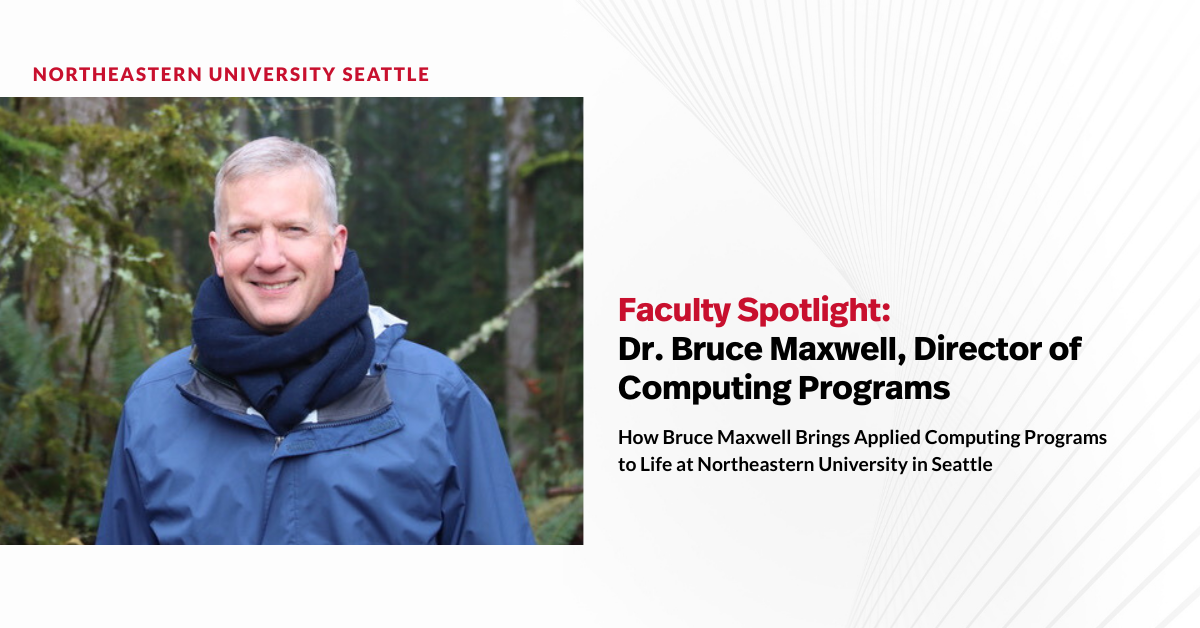
In Dr. Bruce Maxwell’s classrooms, learning isn’t just about reviewing lecture notes. It’s about doing the work. His students tackle messy data, write and revise code, analyze systems, and figure out why models that look solid on paper don’t always hold up in practice.
That practical approach reflects decades of teaching, research, and industry experience in computer vision, machine learning, robotics, and data science. Today, it also informs Maxwell’s work as Director of Computing Programs at Northeastern University’s Seattle campus, where classroom experiences are rooted in strong fundamentals and exploration.
“Two important things I try to teach my students are that they are capable of doing things they don’t think they can do and that the hard work is worth it,” says Maxwell. “If I can teach that, my job is done.”
The Path to the Computer Science Faculty in Seattle
Maxwell’s interest in computers began in sixth grade when his teacher brought an Apple-1 computer into the classroom. He was immediately determined to understand how it worked. Years later, that same curiosity led Maxwell to earn bachelor’s degrees in political science and engineering, a master of philosophy in computer speech and natural language processing, and a PhD in robotics.
“Many engineering courses I took and eventually taught had a lab component, and the philosophy became, ‘If it’s a course, it has a lab,’” says Maxwell of his foundation. “Even if it isn’t a traditional lab, students learn the most by implementing what they hear in lectures and read. That’s what I think teaching is all about, ensuring you teach in a way that will stay with students.”
The belief in teaching students to learn by doing has guided Maxwell’s career. Early on, Maxwell taught engineering and computer science at Swarthmore College for nearly a decade. He then chaired the Computer Science department at Colby College and served as its Data Science Program Director. Alongside teaching, Maxwell led research at Tandent Vision Science, developing computer vision technology that produced dozens of patents and practical industry applications.
Shaping Graduate Programs in Seattle
By the time Maxwell arrived at Northeastern University as a visiting professor in 2020, he was planning to take a sabbatical the following year. The opportunity to help launch the Roux Institute in Portland, Maine, and develop the Align Master of Science in Computer Science program altered his path.
“The challenge and opportunity to bring students with no computer science background into computer science is what first drew me to Northeastern,” he says of Align, which provides a bridge for students from non-STEM backgrounds. “I really enjoy seeing those students bring their history, experience, and knowledge into the classroom as they pivot their careers.”
After two years at the Roux, Maxwell joined the computer science faculty in Seattle as the campus’s Assistant Director of Computing Programs. In 2025, he became Director of Computing Programs. Under his leadership, Khoury College’s Seattle offerings expanded from the MS in Computer Science and Align MSCS to include MS Robotics and MS AI programs.
As Director of Computing programs, Maxwell prioritizes rigorous yet accessible curricula, which he says begins with supporting faculty with resources and professional development. Each week, for example, faculty collaborate to address challenges such as evaluating students in the age of AI and integrating large-language-model-based tools into Khoury programs.
“We have to help students see that understanding core concepts — and even memorizing certain fundamentals — is essential, even when AI can generate code for them,” Maxwell says. “That foundation enables them to move into higher-level design and systems thinking. The goal, then, is to give students practice in synthesis and evaluation: designing systems, assessing code, modifying it, and integrating different pieces into a coherent whole.”
Ensuring Applied Computing Programs Open Doors
Experiential learning puts those skills into action through industry projects or faculty-led initiatives. Situated in Seattle’s tech-rich environment, Maxwell sees growing opportunities to deepen connections between classroom learning and industry practice, drawing on the region’s strengths in AI, cloud computing, and robotics.
“We want our education to equip students to adapt by providing the fundamentals that won’t change, as well as practice with what is changing,” Maxwell says.
It’s an approach aligned with Northeastern University’s emphasis on co-op and project-based courses, and it extends to research as well.
Most recently, students have contributed to Maxwell’s computer vision research, which asks whether the way images are usually prepared for humans is the best approach for machines. His work shows that small changes to image processing can make AI models more reliable, reveal hidden patterns, and improve performance in tasks like object recognition and image generation. The research challenges the assumption that better results require bigger models. Instead, it suggests that smarter data design can often deliver stronger performance with the same, or even less, computational cost.
For students, participating in the research means engaging directly with the kinds of open-ended, evolving problems they’re likely to encounter in industry or advanced research. Over the past two years, Maxwell has published four papers, all co-authored with Northeastern University students.
“For some, it’s a stepping stone toward a PhD,” he says of students’ involvement. “For others, it’s their first experience with research. At its core, research is about learning how to develop a plan and carry out a significant project from start to finish — and that’s a foundational skill that’s valuable in any career.”
By: Izabela Shubair