From Business to Backend: A Pivot to Software Engineering
June 24, 2026
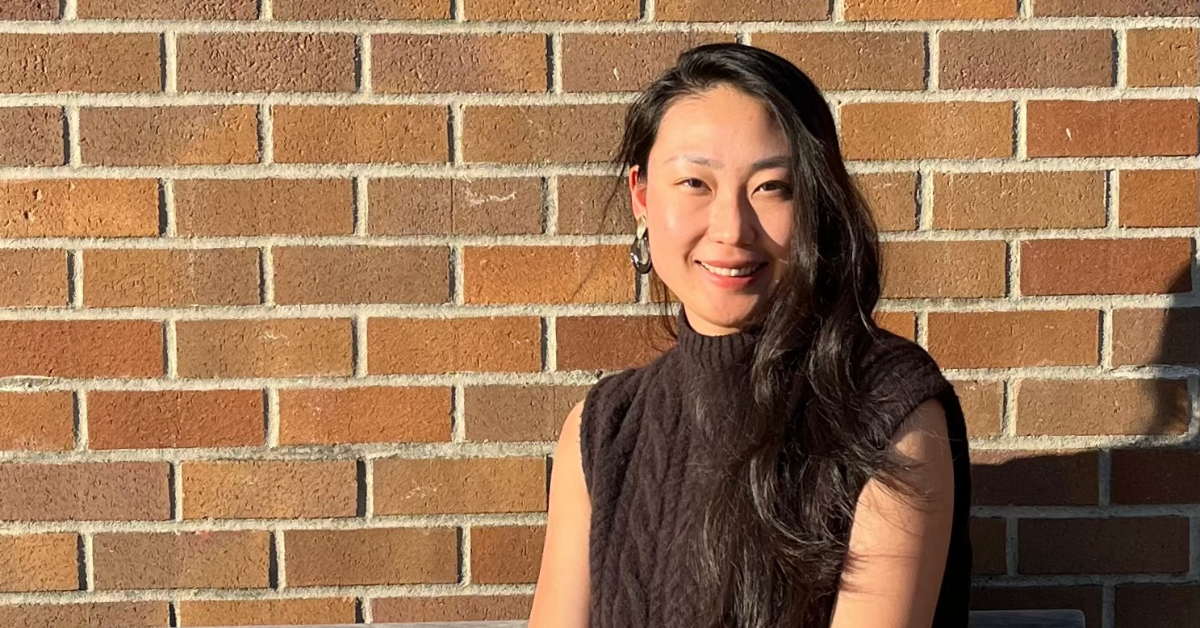
In Singapore, Kaiqi Zhang worked on the business side of technology, supporting TikTok’s top clients with ad solutions. Her role wasn’t technical, but she collaborated closely with engineers. Each backend fix request sparked her curiosity. She began to see engineering as the work closest to solving problems and creating value — and it was where Kaiqi wanted to be.
That’s when she decided to make a bold move into a new field and across the world. Kaiqi enrolled at Northeastern University’s Seattle campus in the Align Master of Science in Computer Science program, a pathway for students transitioning into tech from non-STEM backgrounds.
The pivot came full circle when Kaiqi completed a co-op at Apple as a software engineering intern. The experience, she says, confirmed she is exactly where she belongs.
“My co-op reinforced the idea that I want to dive deeper into the ad tech space,” says Kaiqi. “I struggled with imposter syndrome at first, but a leader at Apple reminded me that feeling that way often means you’re already operating at a higher level. Trusting the process and learning from each experience helped me build real confidence.”
The Fundamentals of a Career Change to Tech
Well before applying her skills at Apple, Kaiqi had learned the value of a strong foundation. She previously made a major leap from a Bachelor of Arts in Russian Language and Literature to a Master of Science in Business with a concentration in marketing. The shift taught her that starting over meant building from the ground up, which is why the Align MSCS program stood out.
“The most important thing for me is learning the fundamentals instead of taking shortcuts,” Kaiqi says. “I really appreciate the breadth and length of the Align program, which gave me time to gain a foundation and explore my career interests.”
That structure mattered to Kaiqi because it balanced coursework with experiential learning, such as co-op. Through the Align MSCS program, offered within the Khoury College of Computer Sciences, she saw a chance to apply classroom concepts in real-world settings and test her interests before choosing a focus.
“I felt like I needed industry exposure to make a better decision about which sub-category of computer science I wanted to enter,” she says. “But this also circles back to what I like about Northeastern: the professors hold senior positions in the industry, and their personal coaching can help you shape your career pathway.”
At the same time, the program’s curriculum equipped Kaiqi with the technical skills she relied on during her co-op. She credits classes in distributed and computer systems, which combine theory with practical experience, for helping her make informed design decisions and successfully execute a complex project at Apple.
Co-op Supports Pivot to Software Engineering
Kaiqi approached her co-op search strategically. She applied widely, keeping in mind that beyond technical skills, interviewers wanted to see curiosity, collaboration, and the ability to think through problems like a teammate.
“They let me know they are there, and that gave me a sense of relief because the co-op process can be stressful,”
During the search and once she landed her co-op, Kaiqi leaned on the campus Career Development team, which made the process feel more manageable. She says advisors regularly checked in, providing guidance and reassurance. “They let me know they are there, and that gave me a sense of relief because the co-op process can be stressful,” she says.
In May 2025, after a successful interview process, she landed in Cupertino, CA, at Apple’s global headquarters. As a backend engineering intern, Kaiqi worked with the team responsible for serving ads across Apple’s apps, including the App Store and Apple TV.
During her internship, Kaiqi worked on a large-scale engineering project that supported critical business operations. She contributed throughout the development process, including requirements gathering, design discussions, implementation, testing, and production-readiness efforts. The experience gave her hands-on exposure to developing multifaceted systems in a collaborative engineering environment.
“The project had significant technical scope and offered opportunities to work on complex engineering challenges,” Kaiqi says. “It was rewarding to contribute to a large-scale initiative and collaborate with talented engineers while gaining experience building systems that support business needs.”
Seattle Tech Education to Career
The role also allowed Kaiqi to work closely with senior leaders and experienced engineers across the organization. During a design review she led for the project, she received positive recognition for her technical approach and preparation. Before the review, Kaiqi proactively incorporated feedback and refined her design through multiple iterations.
The experience, she says, reinforced the importance of continuous learning, collaboration, and thoughtful problem-solving in a fast-paced environment.
“I appreciated the visibility throughout the journey and the chance to learn from leaders,” she says. “For example, I met with senior leaders who were open about their own career pivots and what they wished they could have done differently. Those conversations helped me to recalibrate how I approached the process.”
The co-op didn’t just confirm Kaiqi’s career change; it shaped what comes next. After graduation, Kaiqi will bring the curiosity that first drew her to engineering, along with her Northeastern Seattle foundation and industry experience, back to Apple, where she has been hired as a full-time software engineer.
By: Izabela Shubair