


AI, Longevity, and Tech Research in Seattle with Dr. Ram Hariharan
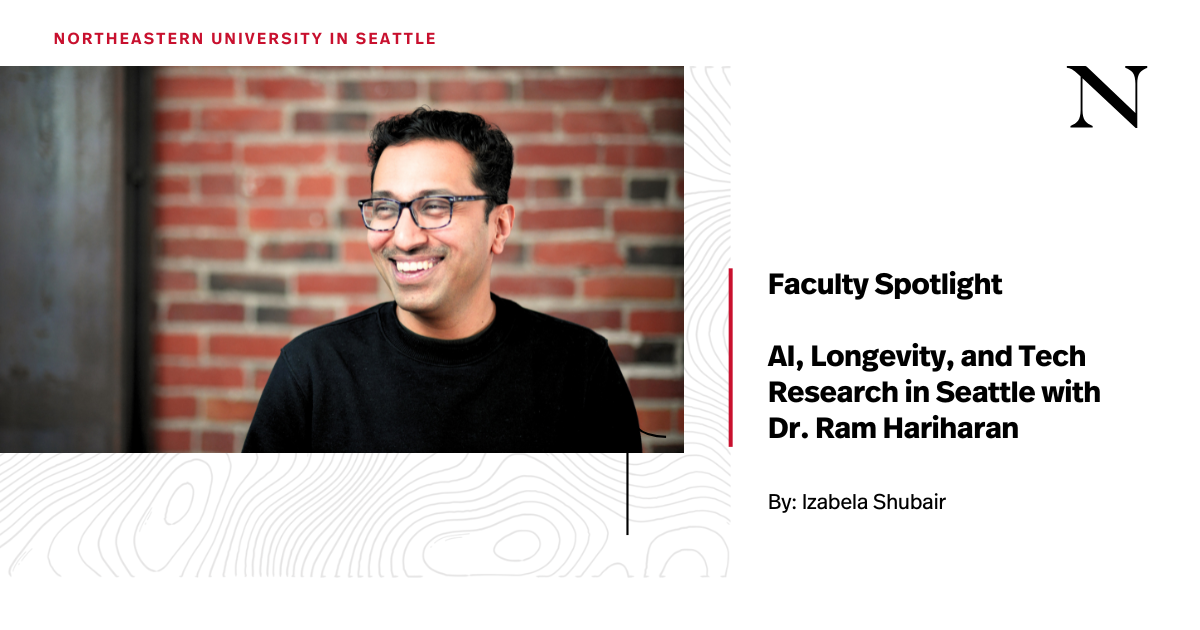
Long before Dr. Ram Hariharan was building AI applications or leading graduate engineering programs in Seattle, he was a child in India listening to his grandmother’s stories. As the family storyteller, she helped shape how he understood the world. When she passed, the loss left Ram asking himself fundamental questions: Why do we age? What causes the body to fail? Could science slow that process?
Those early questions came to define Ram’s career, spanning cancer research, global health, and developing machine-learning tools to understand human aging. Today, Ram continues to apply AI and computational biology to study human aging and health—work that reflects the region’s tech-forward ecosystem.
At the same time, as the inaugural Director of the College of Engineering Programs at Northeastern University’s Seattle campus, Ram is shaping how emerging engineers transition their education into career success in a constantly evolving industry.
“With how fast the tech scene is changing, I am always on my toes,” Ram says. “If we want to help students be ready for what the industry needs, we have to ensure they are up to date. The only way to do that is through the industry, where everything happens. We know we won’t find everything we need to teach our students in old textbooks, but in real-world learning.”
A career built on applying tech research in Seattle and beyond
Ram’s insistence on relevance is rooted in a career spent making real impact in high-stakes environments.
He began his work in computational cancer biology in India before moving into systems biology and genomics research at institutions such as Japan’s RIKEN and the Institute for Systems Biology in Seattle. At Fred Hutchinson Cancer Research Center, meanwhile, Ram developed machine-learning models using genomic, clinical, and imaging data to support precision oncology.
Later, he led applied AI teams as Head of Applied Artificial Intelligence at Macro-Eyes Inc., the first major AI investment by the Bill & Melinda Gates Foundation. There, Ram collaborated with global health partners to leverage data and machine learning to strengthen healthcare supply chains in low-resource locations.
“Throughout my career, I’ve focused on building computational tools that advance science and applying them to large biological data sets,” he says. “A major focus of my work is using that data to understand how aging unfolds, and how to measure it in meaningful ways.”
Advancing AI research at Northeastern University
At Northeastern University’s Institute for Experiential AI, Ram is advancing his work through two active research projects.
The first focuses on aging and includes building an AI-powered platform that allows users to upload biological data. This tool estimates a sample’s biological age, which reflects how well tissues and organs are functioning rather than chronological age.
“Beyond the lab, you find that some populations may be aging faster than others, which also increases their risk for age-related diseases like cancer and cardiovascular disease,” Ram says. “Our research can have huge implications at many levels, from individual care and physicians’ practice to public health policy, including where to focus vaccination efforts or expand access to healthcare.”
The second project applies machine learning to predict patient responses to cancer immunotherapy.
Faculty-led research Seattle students benefit from
Ram’s research also functions as real-world learning for students at Northeastern University’s Seattle campus. At any given time, he works with a small group of typically five or six student research assistants who contribute directly to active projects.
“Students are helping me build foundational models for aging, even as we speak,” he says. “My philosophy is to be a mentor, not a tormentor. I try not to micromanage and only step in when they need support. What matters most is understanding their motivation.”
That individualized approach enables Ram to tailor research roles to students’ goals. Some are interested in the research itself, while others want to strengthen their resumes. In both cases, he says, the aim is to help students translate theory into practice in a way that aligns with where they want to go next.
Seattle’s tech sector offers an immediate extension of that on-campus experiential learning. Located just blocks from companies like Amazon and Google, Northeastern University’s Seattle campus places students close to the industry they hope to join. Ram sees the proximity as both motivating and educational for students in graduate engineering programs in Seattle. For him, it’s also a reminder that preparing students for such environments requires more than technical skills.
“One of the most important things we try to instill is adaptability,” he says. “You have to be open to really dropping all preexisting ideas on how to solve a problem. Some aspects of AI haven’t changed in a while. Others change every minute. Students need strong foundations, but they also need the perspective to embrace quickly changing pieces.”
Combining his two loves
Even as he guides the next generation of engineers, Ram hasn’t forgotten the source of his own curiosity. In 2026, he will return to the foundation that first shaped his work: storytelling. He is preparing to publish his debut book, The Longevity Formula. Co-authored with a leading expert in aging research, it will examine evidence-based healthy longevity with the same thoughtfulness that first drove him to ask those big questions about aging.
By: Izabela Shubair