


Bridging the Gap: From Business Strategy to Human-Centered AI
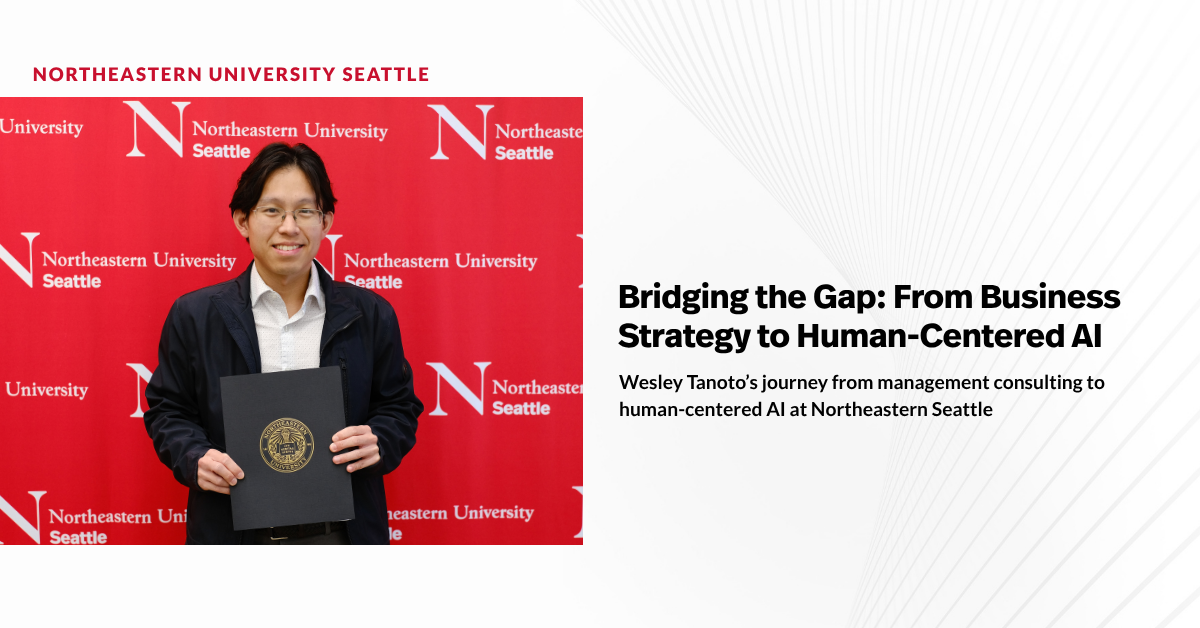
When the COVID-19 pandemic struck in 2020, management consultant Wesley Tanoto was in the middle of a multi-million dollar digital transformation project. He had been tasked with designing a roadmap to digitize and streamline the legacy organization’s core operational functions, which the pandemic made all the more important and complex. His strong Business Administration acumen helped him to excel on the project, but he noticed the industry shifting; legacy organizations were racing to modernize their operations as technology became more complex and the first public LLM models were introduced to the market. Wesley realized it was time for him to upskill too, and gain technical knowledge specific to the field of information systems management to compliment his business know-how.
That ‘aha’ moment prompted the decision to go back to school.
So when Wesley finished his project in 2022, he began looking for graduate programs that would supplement his business administration expertise with tech skills genuinely relevant to his manufacturing industry clients. Northeastern in Seattle’s MS in Information Systems Bridge program – which supports students from non-technical backgrounds to succeed in technical fields – stood out. Along with the university’s co-op program and the Seattle campus’s proximity to western Washington’s industrial manufacturing sector, it fit the bill perfectly, and Wesley enrolled in 2023.
“Information Systems management is often misunderstood as a generalist field,” Wesley said of his choice of program, which marries software engineering and design know-how with the critical thinking, communication, and collaboration skills to ensure a technical system responds to the real needs of its human users.
“To create that connection between human and system, you need domain knowledge of information systems, and that is exactly what I got from my course of studies at Northeastern.”
His chance to check his classroom learning against clients’ real-world needs came in the spring of 2025, when Wesley landed a co-op with Seattle’s Kocer Consulting and Engineering. In four months, he contributed to nine different projects, from developing AI-assisted shop floor maps to implementing predictive maintenance models to keep manufacturing equipment running safely. One of his favorite projects was working out how to ethically implement AI in the creation of a safety manual.
“It’s an automated industrial-grade saw machine for cutting wood – the manual has to be OSHA-approved, it has to be compliant with all the U.S. Department of Labor and state regulations, and it has to be able to be deployed quickly,” Wesley said. His technical expertise was useful here because it built on his existing knowledge in the domain of manufacturing systems; ”You need to be able to steadily check AI’s work to ensure that it meets your specifications and the professional standards. If you take that domain knowledge and bring in AI, then AI becomes a tool for people like me. I was able to implement AI to help them create a manual that is compliant with those standards – state and federal – and put it into training for people, all that in four months.”
Kocer Consulting and Engineering was thrilled with Wesley’s performance. For his part, Tanoto was delighted by the opportunity to test his learning in the real world in such a wide variety of ways.
“I was wearing multiple hats – literally, and safety goggles,” he laughed. “Anywhere else, I wouldn’t have that opportunity to take a full-time break from school, to get practical training that allows me to pursue all my interests at once.”
Wesley took his love for experiential learning into the classroom, too. For two semesters, he served as a TA for Experience Expo, a collaborative experiential learning course piloted at Northeastern in Seattle.
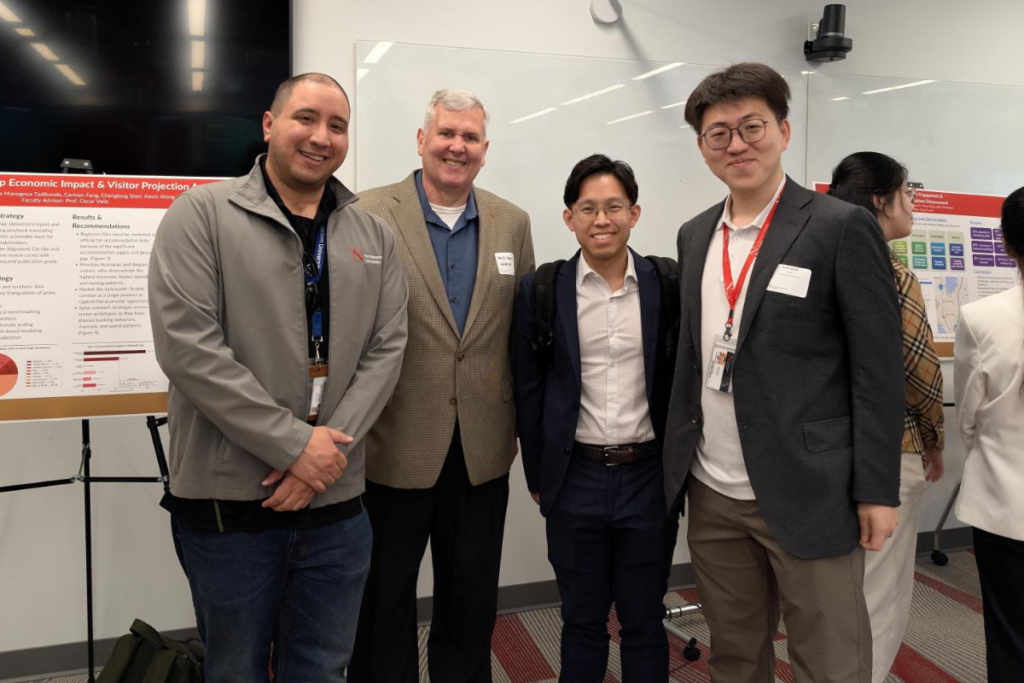
”We bring students from multiple disciplines – computer science, industrial engineering, data analytics, information systems, project management – together to create this mini consulting project, where we work with actual business organizations or nonprofits here in Seattle. It’s like an internship, in the umbrella of a class,” Wesley explained. “It was a very enriching experience because I was able to practice my skills as a project leader, but at the same time, help students communicate with clients and faculty. It’s a highlight of my time at Northeastern.”
His contribution in the last two semesters as a teaching assistant landed him a College of Engineering Outstanding Graduate Student Teaching, Service, and Leadership Award.
As Wesley prepares to graduate in May, he’s been mulling over a recent MIT report that 95% of organizations implementing Generative AI aren’t seeing a return on their investment. He can’t help but think of the many businesspeople who must be standing where he stood in 2020: aware they’re facing a technical gap, but unsure how to use new technologies to supplement their own expertise effectively.
”I want to be the bridge for systems and AI adoption in a responsible, ethical, and human-centric way, because those are the key things for success. It has to be intuitive, easy to understand, intentional, and ethical, so whoever uses the systems will see it as a tool.” Wesley said. “I don’t want to be pro-AI or against AI; I want to be an informed participant, able to leverage and coexist with AI. This is something that we cannot avoid – it exists already – so, I want to use it for the greater good of the people around me, and myself as a professional.”
And for those who prefer learning to fill the gap themselves to hiring professionals like Wesley, he encourages them to follow their gut.
”Nothing is wrong with investing with yourself in very uncertain times,” he said. “If you see a pathway with value in it, and you believe that is aligned with who you are as a person, don’t hesitate. Just do it.”
By: Madelaine Millar