


In Step with Seattle: Northeastern University Robotics
Earlier this year, Recology, a waste management and resource recovery company, installed AI-powered robotic sorters at its King County material recovery facility (MRF) in Seattle. The move marked a step forward in using automation and machine learning to streamline sustainability efforts. Just a few miles away, near Pike Place Market, Artly Coffee’s robot barista, Jarvis, makes lattes with precision by leveraging computer vision, imitation learning, and deep learning.
These innovations aren’t isolated. They reflect a broader shift toward integrating intelligent systems and human-centered design across industries. They also represent the focus of Northeastern University’s newly launched Master of Science in Robotics (MS in Robotics) program in Seattle, where regional momentum informs the curriculum.
The Landscape of Robotics Jobs in Seattle
Seattle’s advanced automation sector isn’t just visible—it’s booming. The field is anchored by major players like Microsoft, Amazon, Tesla, Teradyne, and NASA JPL. Amazon, for example, deploys 750,000 robots across its facilities, with projections to surpass one million by next year. The company, headquartered next door to Northeastern’s Seattle campus, is now one of the world’s largest users of industrial robots.
Startups like Carbon Robotics, WiBotic, DroneSeed, Sewbo, Olis Robotics, and Anduril are also expanding automation’s range—from agriculture and defense to surgical assistance and environmental sustainability.
Unsurprisingly, the region ranks among the top U.S. robotics hubs, offering strong career prospects. Glassdoor estimates automation engineers in the city earn an average of about $156,000 annually, with base pay around $121,000. Experienced professionals can make over $200,000. Demand for roles like mechatronics, electrical, computer hardware, and mechanical engineers continues to rise across the metro area.
The local economy supports this progress. The metro area posted a GDP of $566 billion in 2023, making it the fastest-growing among large U.S. metro regions. Fenwick, a law firm for tech and life sciences companies, reports that while tech jobs make up just 13 percent of the workforce, they generate 29 percent of the city’s economic output. This underscores the sector’s outsized impact and need for skilled professionals.
From Robotics Jobs in Seattle to a Growing Global Talent Market
Seattle’s momentum is part of a larger picture. The Bureau of Labor Statistics forecasts job growth of 9 percent for electrical and electronics engineers, 11 percent for mechanical engineers, 7 percent for computer hardware engineers, and 26 percent for computer and information research scientists—roles relevant to the automation space—between 2023 and 2033. According to Precedence Research, meanwhile, the global robotics technology market reached $94.54 billion in 2024. It’s projected to top $372.59 billion by 2034, increasing at a compound annual growth rate of 14.7%.
The World Economic Forum’s Future of Jobs Report 2025 also names robotics and automation among the most transformative trends through 2030, with 58 percent of employers expecting them to reshape their businesses. The report highlights demand for related skills—including AI and technological literacy—both embedded in Northeastern’s curriculum.
Northeastern University Robotics Program Launches in Seattle
Launching in Fall 2025, the Robotics graduate program is designed for students with backgrounds in computer science or mechanical, electrical, and computer engineering, who want to reskill or pivot careers. The interdisciplinary program approaches the field from three connected angles: mechanical engineering, electrical and computer engineering, and computer science. Students select one of these core disciplines to develop in-depth technical expertise in algorithms, sensors, control systems, and mechanical components that power intelligent machines.
They can further personalize their studies through electives in areas such as mechatronic systems, robot mechanics, control systems, AI, sensing and navigation, mobile and field robots, and machine learning.
Where Robotics Graduate Programs Meet the Real World
Immersive opportunities are central to Northeastern University’s commitment to experiential learning.
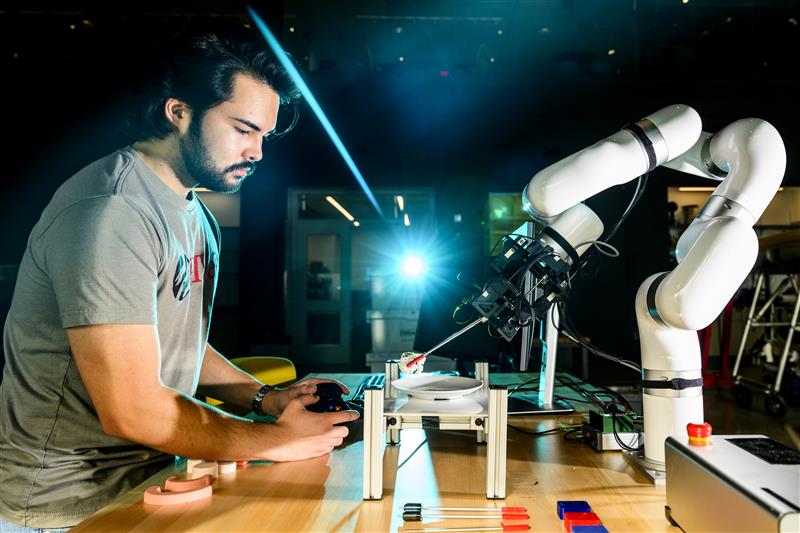
In advanced laboratories, for example, learners gain hands-on experience with robotics systems supported by cutting-edge equipment. Initiatives like XN projects—course-aligned collaborations with industry partners—allow them to apply their skills in meaningful, short-term industry engagements. Northeastern’s co-op program, with its 115-year history and 3,850 global employer partners, also strengthens applied learning and offers a direct pathway to professional growth and networking. Nearly 1,100 co-op and internship placements have been facilitated at the Seattle campus alone.
Applied learning even includes faculty-led research. Students work alongside experts across multidisciplinary centers, such as the Institute for Experiential Robotics, which focuses on adaptive, collaborative, human-centered systems. The MS in Robotics Seattle faculty—drawing from backgrounds in finance, biomedical science, education, and engineering management guides students through courses, mentorship, and joint research to bridge theory and practice.
On campus, students will soon benefit from the Seattle Advanced Manufacturing and Community Experiential Learning Lab (SEAMCELL). Designed as a nexus of education and industry collaboration, SEAMCELL will support graduate programs while also serving as a maker space for local organizations—fostering community partnerships and interdisciplinary learning.
Delivered in a city where robotics innovation and opportunity are everywhere, from coffee shops to waste management plants, the degree positions students to step directly into high-impact roles, locally and globally.
Explore how Northeastern University’s Robotics program in Seattle can equip you to lead in the global innovation economy.
By Izabela Shubair
Sources:
https://www.precedenceresearch.com/robotics-technology-market
https://distributionstrategy.com/amazon-reaches-750000-robots-in-fulfillment-operations/
https://www.ft.com/content/31ec6a78-97cf-47a2-b229-d63c44b81073
https://www.builtinseattle.com/companies/type/robotics-companies/
https://www.builtinseattle.com/articles/seattle-robotics-companies
https://en.wikipedia.org/wiki/Seattle_metropolitan_area
https://www.oxfordeconomics.com/resource/pacific-northwest-to-withstand-challenges-and-lead-growth/
https://www.bls.gov/ooh/architecture-and-engineering/mechanical-engineers.htm
https://www.bls.gov/ooh/architecture-and-engineering/electrical-and-electronics-engineers.htm
https://www.bls.gov/ooh/architecture-and-engineering/computer-hardware-engineers.htm
https://blog.dol.gov/2024/09/06/new-bls-employment-projections-3-charts
https://robotics.northeastern.edu/
https://www.forwardpathway.us/federal-funding-fuels-advanced-manufacturing-lab-development
https://news.northeastern.edu/2024/10/04/advanced-manufacturing-lab-seattle-funding/